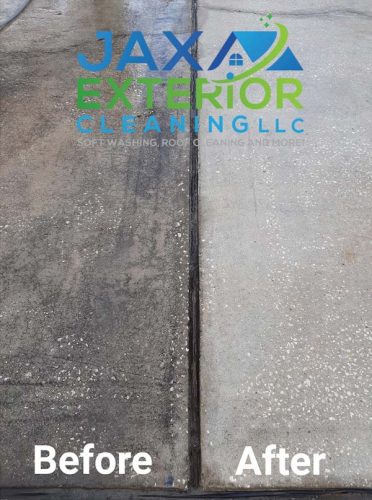
Concrete goes black in Florida. Between the humidity, the shade and the rain, driveways and sidewalks grow a layer of algae and grime that a hose won't touch — and most people stop noticing until they see a clean one next door.
We've been pressure washing in Jacksonville since 2019. Here's what we clean, what we don't, and why the difference matters.
What We Pressure Wash — and What We Never Do
This is the part that separates a good contractor from an expensive mistake.
High pressure is right for: concrete driveways, sidewalks, curbs, patios, pool decks, block walls and other hard flatwork. On concrete, pressure plus a surface cleaner is exactly what you want.
High pressure is wrong for: your siding, your roof, and your pavers. Aimed at siding it forces water behind trim and strips paint. Aimed at shingles it takes the granules off and shortens the life of the roof. Aimed at pavers it blasts the joint sand out and leaves you with shifting stones and weeds.
Those surfaces get a soft wash instead, or in the case of pavers, a proper clean, re-sand and seal. Plenty of companies run one machine at one setting across everything. We don't.
Signs Your Concrete Needs Cleaning
The driveway has gone grey-green or black
That's organic growth, not dirt. It thrives in shade and humidity, and it comes back thicker each season if it's left alone.
The sidewalk gets slippery when it's wet
Algae on concrete is genuinely slick. This is the one worth fixing before somebody goes down on it.
Rust or orange staining
Usually irrigation water, fertilizer, or metal furniture left sitting. It needs treating, not just blasting.
Oil spots and tire marks
Common where cars park and turn. These need a pre-treatment to break down before any pressure goes near them.
Stripes and zebra lines across the concrete
That's the signature of a wand instead of a surface cleaner. Somebody cleaned it in overlapping arcs and left the pattern behind.
Why We Use a Surface Cleaner, Not a Wand
A wand cleans in a narrow fan, so the operator sweeps it back and forth and you end up with the striping you've seen on half the driveways in town. It's uneven, and once it's there the only fix is doing the whole slab again.
A surface cleaner is a rotating head inside a housing that covers a wide path at consistent pressure. The result is one even finish across the whole surface with no lines, no arcs and no missed strips.
It's also faster and it keeps the spray contained instead of blasting dirt across your garage door and landscaping.
Our Process
We pre-treat the concrete first with a cleaner that loosens the dirt, mold and mildew and breaks down organic growth at the root. Letting that dwell is what makes the difference between clean and clean — pressure alone strips the surface layer and leaves the rest to come back in a few months.
Then we run the surface cleaner across the whole area for an even finish, edge in around borders and tight spots, and rinse everything down, including any landscaping nearby.
We use your outdoor spigot for water, so nothing needs arranging ahead of time. Our work carries a 90-day craftsmanship guarantee.
How Often Should Concrete Be Cleaned?
Once a year for most Jacksonville properties. Shaded driveways, anything under trees, and north-facing walkways may want it more often.
If you want it to stay clean longer, concrete sealing is worth asking about — a sealed slab resists staining and organic growth far better than raw concrete.
Also Worth Doing at the Same Time
We're on the property with the equipment already, so combining saves you a visit. Most customers pair a driveway with a house wash, a roof cleaning, or their paver sealing.
Areas We Serve
We pressure wash in Jacksonville and about 25 miles out — St. Johns County, Ponte Vedra, Nocatee, the Beaches, Mandarin, Fleming Island, Orange Park, Yulee, Amelia Island, Fernandina Beach, Fruit Cove and Arlington. Florida only. We do not currently service westside or northwest Jacksonville.
Frequently Asked Questions
Will pressure washing damage my concrete?
Not when it's done right. Concrete handles pressure well — the damage people worry about comes from using high pressure on the wrong surfaces, like siding, shingles or pavers.
Can you pressure wash my pavers?
Not the way we'd clean concrete. High pressure blows the joint sand out from between pavers, which leads to weeds, ants and shifting. Pavers get cleaned, re-sanded and sealed — that's a different service and it's our specialty.
Will the black come back?
Eventually, because this is Florida. Pre-treating kills the growth rather than just knocking it off, so it stays gone far longer than a pressure-only cleaning. A yearly wash keeps ahead of it.
Can you get out rust and oil stains?
Usually a significant improvement, sometimes complete removal — it depends how long they've been sitting and what caused them. We'll be straight with you at the estimate about what we can and can't get out.
Do I need to be home?
No. The estimate takes about 5 to 10 minutes and you don't need to be there.
Why does my neighbor's driveway have stripes on it?
Somebody cleaned it with a wand instead of a surface cleaner. It's the most common pressure washing mistake and it's why we don't work that way.
Get a Free Pressure Washing Estimate
Fill out our free estimate form or call 904-444-9190. Estimates are free, you don't have to be home, and Zach will get in touch with you about times and scheduling.
Licensed and insured, in business since 2019, with 200+ Google reviews at 4.7 stars. Cash, check, Zelle and Venmo accepted, with a 5% discount for cash.